
For fifteen years, Gary Larson created hilarious and memorable single-panel comics for his comic strip, The Far Side. While he had an extraordinary run of unique jokes that invoked the prosaic in a world of absurd reality, he often returned to subjects that seemed to be fertile beds for his imagination. Dogs, cows, and Mr.
And Mrs. Suburb repeatedly found their way to his panels. Aliens were another frequent visitor to The Far Side.
Once primarily the domain of fringe conspiracy theorists, UFO sightings (now known as UAPs or Unidentified Aerial Phenomena) are now being reported on the mainstream news. In the summer of 2023, the U. S.
House of Representatives Oversight Committee held hearings on UAP sightings, claiming it was a bipartisan concern for national security. Some will turn to the government to guide them if humans are toured by alien life. Others will turn to The Far Side in future comic strip outings.
Gary Larson was not afraid to take The Far Side to dark terrain during its initial 15-year run. Whether it was jokes about suicide or the destructive capacity of human nature, Larson's humor could get morbid; such is this panel. The worst possible extent of human destruction makes for great entertainment on the moon In this joke, Far Side aliens are gathered on the moon, looking up at a distant Earth.
With wide eyes and open mouths, responding with long oooo's, they watch as nuclear war erupts on Earth with great mushroom clouds. The destruction of humanity is merely a flashy fireworks show for aliens. Ever since the Soviet Union rolled out Sputnik into space, The US National Aeronautics and Space Administration (NASA) has put space exploration on the front burner, sending probes and, eventually, manned missions up into space.
Unmanned explorations have continued and included probes going to Mars. But in The Far Side, space exploration has disastrous consequences. In this panel, a probe is exploring the surface of a barren planet.
But in the background, a giant, savage-looking alien, stands on a mountain and points up to space shouting,"FIND THEM." Meanwhile, large, classic-looking UFOs launch into space. One of the ironies of this comic is that the probe is named Explorer II.
In the real world, the Explorer II was an unmanned space probe rolled out in 1958, but when the rocket's fourth stage failed to ignite, it failed to reach orbit and crashed into the ocean. In this panel, Gary Larson puts two of his favorite topics together: aliens and idioms. Throughout The Far Side's initial run, Larson created a vast library of jokes based on common idioms.
Here, he takes the idiom"Give me five"And applies it to two young aliens meeting on the street. With just the addition of one number, the expression takes on a strange flavor. No one would consider stating"Give me six"—assuming people still use the expression—because the expression is based on the number of digits on a human hand.
Clearly, adolescent aliens have a few more digits to work with than humans. The Far Side often depicts aliens traveling through the galaxy as if on vacation and behaving much like people do when they visit a foreign country. Everything seems neat and novel because it is in a different context.
Even before cell phones, tourists were renowned for taking pictures of friends or relatives posing. In this Far Side panel, Larson displays aliens stopped at a farm. With their ship in the background, one alien holds up an old-style camera and takes a picture of a friend posing with a scarecrow.
They may think the scarecrow is a novelty in this wordless Far Side panel, but it's also possible that they think they have found a friendly human being. In one of the funniest panels from The Far Side, Larson incorporates aliens to make a point about human nature. People can get so locked into their routine that they can't see beyond their circumstances to the larger consequences of events.
Sometimes it seems like even drastic circumstances aren't enough to shake people out of complacency. In this panel, the reader looks down into a normal-looking house while flying saucers crowd the sky. A woman stands in the front window of the house and looks up at the sky.
But is she concerned about the alien craft massing above her? No, she tells her friend that her set is also out — "And in the middle of Lavern and Shirley." There is a whole sub-category of Far Side alien cartoons about aliens and humans encountering each other for the first time.
If an alien encounter is imminent, government leaders would do well to learn from Larson all how it can go wrong. In this panel, one alien struggles with the language and isn't quite able to get the right word for the leader. And so, in The Far Side's June 11, 1983 release, the classic "Take me to your leader" Moment gets bungled.
How many old science fiction movies have begun with just such a moment and ended with the terror of alien conquest? This is likely what is behind this joke. There may also be a veiled reference to "How to Serve Man," An episode from The Twilight Zone in which the protagonists discover the aliens really mean something more like "How to Cook Man."
In this Far Side panel from August 4, 1982, an alien farmer, complete with overalls and a fence through which his human livestock could easily squeeze, throws out bits from a sack labeled "Earthling Food." The humans scramble about for their portion, as the farmer calls, "Yakity yak yak yak" To get their attention. Once again, Larson can call to mind a shared knowledge about cows and how people typically get them to come.
Somehow, it's part of the human consciousness that if one is seeking a cow to come, one calls out,"Moo!" While cows in The Far Side talk, real cows actually"Moo"To each other as a form of communication. Moms will call out to fell short of calves by mooing.
The herd often communicates a need for help, a desire to mate, or a desire for the other cow to back off. Like this alien farmer, humans have no idea what they're saying when they say moo. In several Far Side comics about aliens, Larson turns the alien spaceship into the family car (which is always shaped like a classic UFO).
It makes that momentous and fearsome moment of an alien encounter feel more like shared moments of childhood vacations. In this July 16, 1982 panel, two aliens are caught out in a field, with one staring glumly through the glass dome of their ship. The scolding that the alien partner gives the one staring into the glass is like what might happen if Larson's typical husband, wife, child, and dog were stuck out in the desert without a towing service for miles.
Of course, that very same human family can be seen in the distance of this panel, charging toward the aliens, leaving them no alternative but to try to talk their way out of this. In one of his many variations of the alien/human encounter from October 26, 1982, Larson depicts two very large green aliens that have captured two boys riding their bikes (out in the middle of nowhere by the looks of it, which is amusing in and of itself). The boys find themselves going headlong into a karmic collision.
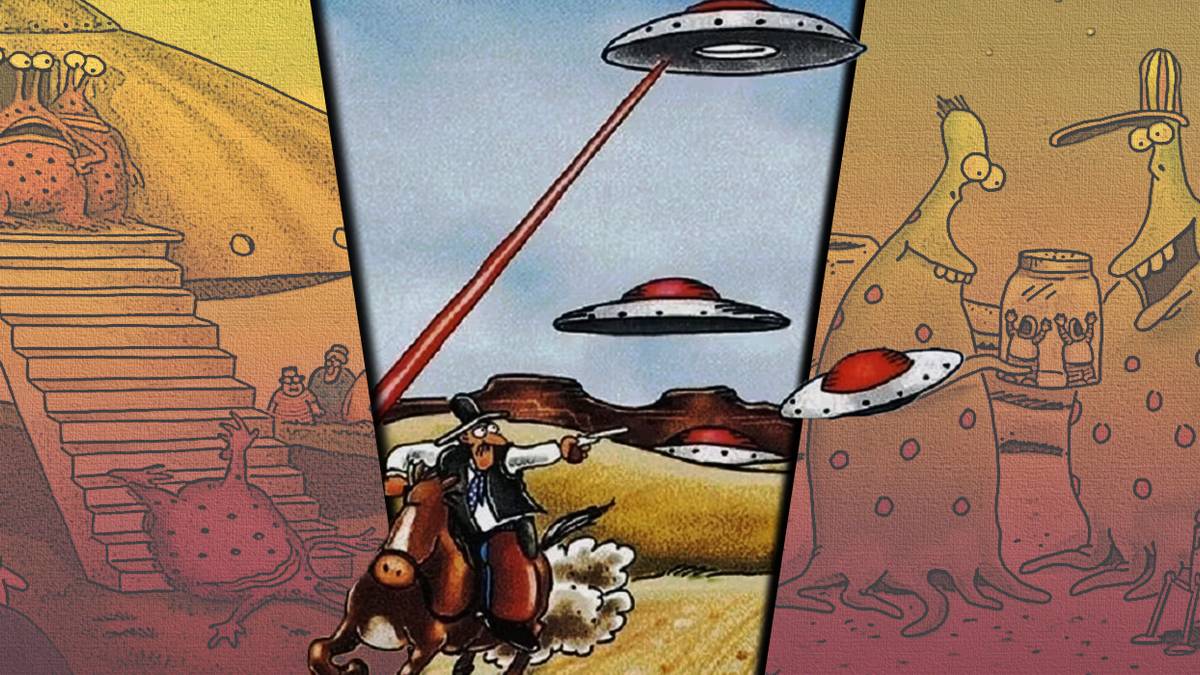
One thinks of the typical American child capturing a creature of some kind and wanting to keep it. The parent usually states,"Punch holes in the lid so it can breathe." Here, it's the alien Gorok who needs to be reminded.
He forgot about the last couple of kids they caught. Suddenly, The Far Side goes to the dark side, and the image of children suffocating in a jar comes to mind. Larson often flips the script this way, commenting on a typical childhood activity that elicits both a laugh and a grimace.
Once again, Larson takes something that could easily happen in the family car (while on vacation) and makes it happen to aliens while the family in question watches on from a distance. In this panel from August 11, 1981, two Far Side aliens sit outside a crashed ship, and one is scolding the other. It seems a bee got into the ship, causing the alien to freak out and crash it.
Many readers relate to this by being the driver or the passenger of a car when a bee gets caught inside. Trying to drive and swat a bee away simultaneously is never a good idea. Still, it becomes hilarious when this typical scenario is put in the context of aliens crashing on Earth.
Comic strips often use simplified, stylized art, but the best cartoonists can convey more advanced artistic techniques despite this stylization. The Far Side had some of the best art in comic strips, with Larson using carefully considered composition, detail, and expressive linework to convey surreal or unexpected situations in his single-panel comics. This Far Side comic is a great example of Gary Larson’s attention to artistic detail.
The comic itself shows an alien couple with many eyes protruding from tentacles on their heads. One alien is accusing the other of infidelity after seeing another alien’s eye under the bed. The small details of one single eye-stalk protruding from under the bed and the alien landscape outside the window truly set the scene for the comic’s humor.
Many people wish that humanity would make contact with beings from another planet. However, as that possibility becomes more likely, there is also a great fear that first contact may not go as well as people hope. If an alien race is technologically superior to humanity, there is a real risk that first contact could go wrong for the people of Earth.
Gary Larson is well aware of the possibility of alien contact going wrong, but as usual, he can turn that fear on its head for his Far Side comics. In this classic strip, a race of aliens who look like hands has landed on Earth. The aliens were not hostile, but in The Far Side, first contact goes wrong due to a simple misunderstanding after a Far Side farmer shakes one alien by the head in greeting.
The Far Side comics have used many recurring characters and settings, from animals who mimic human behavior to rocket scientists who lack common sense. One frequently used group of characters in The Far Side is Cavemen. Larson often used these prehistoric figures to highlight elements of ignorance that still exist in modern “Civilized” society.
Although cavemen in Far Side comics usually illustrate issues of modern society through contrast, Larson sometimes used them for simple visual gags. This strip from January 16, 1991, was one of the latter, merging one setting, Cavemen, with another, aliens. Presumably, a UFO would be technologically advanced at any time in history.
Through the surreal lens of The Far Side, however, UFOs spotted by cavemen were made from sticks and rocks. Life is full of misunderstandings, even between people from the same society. If humans with a common background can’t always understand each other, how would aliens fare?
Larson has imagined that very scenario in this comic strip about an alien approaching humans for the first time. In this Far Side comic from November 11, 1982, an alien is comically disguised as a human. It has approached a couple of rough-looking human men, who have threatened it.
The comedy in this strip arises from the alien’s misunderstanding of English idioms. Although the alien can speak English, it clearly doesn’t understand the term “Knuckle sandwich” and, therefore, is unwittingly asking to be hit by the two thugs. If someone mentions “Cowboys and Aliens,” many will first think of the 2011 science fiction film starring Daniel Craig and Harrison Ford.
For fans of The Far Side comics, however, the phrase immediately brings to mind this strip, which predated the movie by 17 years. Only the writers of Cowboys and Aliens know whether this classic Far Side cartoon influenced the creation of a movie with a remarkably similar name. “Cowboys and Indians” was a well-established but poorly-aging trope in media.
Western movies often pitted white settlers and ranchers against local indigenous people. Children at the time often played together using roles inspired by those scenarios. On September 2, 1994, The Far Side turned that notion on its head by pitting a cowboy against laser-wielding UFOs instead.
The humor is further driven home by the caption’s implication that this is a common scenario. Most comic strips today use multiple panels to tell a linear story. The Far Side was unusual because it almost always used a single panel for its comics.
The Far Side’s concise, single-panel format is a testament to Larson’s skill as a cartoonist, as it is extremely difficult to tell a complete and humorous story using only a single image. Nevertheless, the strip achieved this feat hundreds of times over the years. Despite Larson’s skill with single-panel comics, sometimes a story needs more.
This is one of the rare Far Side cartoons divided into multiple panels. The level of artistic skill is still evident, however, as he tells a clear, concise story with very few words. The caption on the comic, “Henry never knew what hit him,” adds a pun to the depiction of a bizarre practical joke, a concept that is somewhat "Alien" To the lore of human and extra-terrestrial encounters.
The Far Side was one of the most popular comic strips ever, partially thanks to its ability to use the surreal to comment on reality. Everyone (other than conspiracy theorists) knows that American astronauts landed on the moon. The moment was an exciting achievement of daring and skill that got humankind to the moon.
This Far Side comic imagines what might have happened if things had gone a bit differently for Earth’s astronauts. Massive alien children hold a jar containing two astronauts next to their lunar lander. Readers can easily connect the behavior of children on Earth with bugs and these aliens.
The result is funny but also a bit sad. Everybody dreads doing something stupid in front of other people. Speaking or appearing in front of a large public crowd is a nerve-wracking experience for most people, and a lot of that fear stems from the idea of doing something embarrassing.
The internet is full of “Fail” videos where people have fallen off modeling runways or stages. In this Far Side comic, the fear of embarrassment has been transferred to aliens arriving on Earth. A crowd has gathered to view the UFO that landed, and three of its four alien inhabitants are standing in the doorway at the top of a flight of stairs.
The last alien is lying prone at the bottom of the stairs after an obvious fall. The accident, plus the other alien’s verbal response, gives the reader some comfort that perhaps aliens aren’t so different from humans after all. Comic strips often draw from universal experiences and reference current cultural events and trends.
However, Gary Laron seldom used explicit pop-culture references, and this panel is the exception that proves the rule. In the 1980s, one of the biggest movie franchises to hit cinemas was the Alien movies, and in 1986, James Cameron’s sequel Aliens became an instant classic. The creepy, H.
R. Giger-designed Xenomorph aliens remain one of the most distinctive elements of the franchise. Xenomorph aliens have appeared in many comic books over the years with varying success.
This Far Side comic was extremely timely, being published just a few months after the release of Aliens on October 5, 1986. The terrifying alien creatures have been tamed by placing them in the extremely familiar setting of the family dinner. Placing the “Face-hugger” young aliens at a kid's table assists to make the terrifying creatures seem even more comical.
Humans run rampant over the natural world and do whatever they like to the nearby plants and animals. Larson has a great degree of love and respect for nature and animals, and this was often reflected in his comics. Sometimes, that affection is overt, as when he makes animals victorious over humans.
Other times, Larson’s message is more subtle. In this panel from November 15, 1987, a boy and his dog encounter a group of aliens with nets who are about to capture them and place them in a museum in another world. The concept is funny, but there is also a deeper layer of meaning, as readers are forced to compare the aliens’ treatment of humans with humans’ treatment of animals, considering their attitudes and actions toward other forms of life.